Development of the Head & Neck

Yayy Pharyngeal Arches

Face & Palate

Five Facial Folds Fuse to Form the Face

The Facial Bulges (Weeks 4–6): Facial primordia

During week 4, five prominences form:

  • Frontonasal prominence → forehead and nose
  • 2 Maxillary prominences → cheeks and sides of the upper lip
  • 2 Mandibular prominences → lower lip and jaw
Both the maxillary & mandibular prominence is formed as an outgrowth of the first pharyngeal arch. This is distinct from the tissues surrounding the forebrain - the frontonasal prominence of neural crest cell origin. Therefore, abnormalities generally occur in one or the other.
  • Frontonasal prominence → forehead and nose
  • 2 Maxillary prominences → cheeks and sides of the upper lip
  • 2 Mandibular prominences → lower lip and jaw
The mandibular prominence is the first to fuse!
Nasal Placodes (end of week 4)

Nasal placodes are ectodermal thickenings within the frontonasal prominence & are the precursors of the olfactory epithelium

  • Nasal placodes (blue) are surrounded by mesenchyme.
  • The mesenchyme forms elevations → 2 medial nasal prominences and 2 lateral nasal prominences.
  • The nasal placodes invaginate to form nasal pits.
  • Nasal pits → nasal sacs → left and right nasal cavities.
    • Intermaxillary segment = space between the fused medial nasal prominences
    • Nasolacrimal groove = cleft between the lateral nasal prominence & maxillary prominence
  • The left and right nasal cavities are separated from the oral cavity by the oronasal membrane.
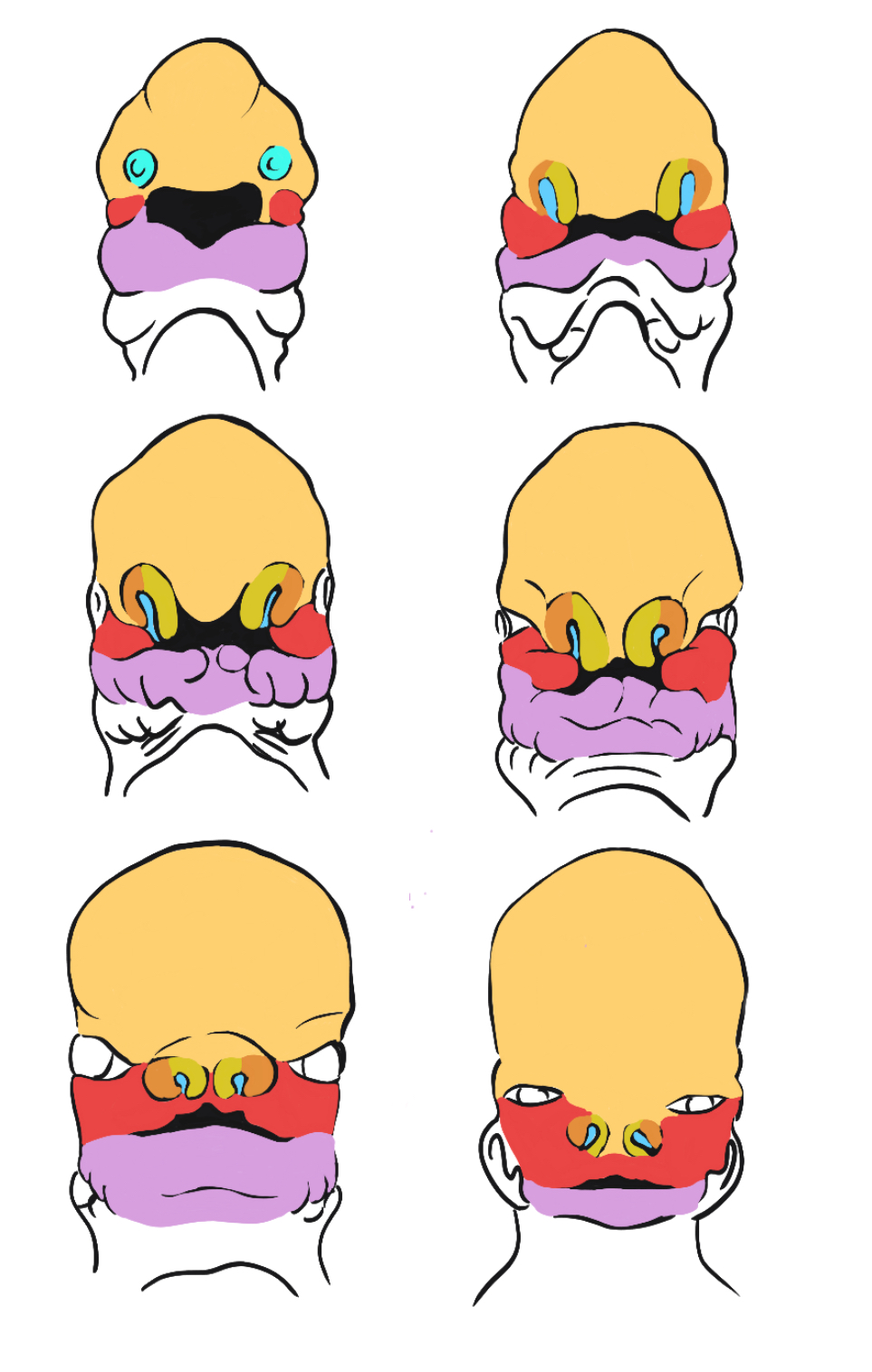
Development of the nasal placodes

The oronasal membrane

  • The oronasal membrane = separates the nasal cavities from the oral cavity
    • → Posterior to the primary palate
    • → Ectodermal
    • → Fused oral & nasal epithelium
  • This membrane breaks down, forming an opening between the nasal sacs & primitive oral cavity, called the primitive choanae
    • → There are two primitive choanae, one for each nasal cavity
  • The secondary palate later grows to separate the nasal cavity from the mouth
Feature Merging Fusion
Basic meaning Two facial processes come together and the groove between them disappears. Two facial processes grow toward each other, touch, and join.
What happens to the epithelium The groove is filled in as tissue proliferates; the surface becomes smooth. The epithelium breaks down where the processes meet.
How the processes join By elimination of the groove between the processes. By direct contact and union after growth together.
Speed of growth The tissue in the groove “catches up” by growing faster than surrounding tissue. The processes move toward each other until they meet.
Result A continuous surface forms without a deep cleft. A midline union forms after epithelial breakdown.
Examples Merging of the two mandibular processes, two medial nasal processes, lateral nasal with maxillary processes, and mandibular with maxillary processes. Formation of the secondary palate.
Clinical importance Failure leaves a facial cleft or persistent groove. Failure causes a cleft palate or other fusion defect.
Kurosaka et al, 2021

Gata3 KO Mice

    Background:
  • gata3 is normally expressed at high levels during primitive choanae development
  • gata3 mutations are associated with hypoparathyroidism, sensorineural deafness and renal disease (HDR) syndrome
    Experiment:
  • The researchers crossbred mice carrying floxed Gata3 with mice expressing tamoxifen-inducible Cre-ERT2, generating offspring in which Gata3 could be deleted after tamoxifen administration.

  • Results:
  • Temporal excision of Gata3 → reduced proliferation of epithelial & mesenchymal cells → failure of privitive choanae development

  • Significance:
  • Causation: gata3 is essential for normal craniofacial development
  • Temporality: gata3 likely has a critical developmental window
  • Relevance: GATA3-KO mice may provide relevant insights into related congential disorders, e.g. choanal atresia
xxxx

Cleft Lip

  • Cleft lip occurs dur to failure of fusion of the maxillary proximinence & medial nasal processes (purple & green in the above diagram).
  • xxx

Choanal Atresia

  • Choanal atresia is a congenital blocking or narrowing of the posterior nasal passage by bone or tissue
  • It may be unilateral or bilateral, diagnosed with a nasal endoscopy
  • Babies will present with difficulty breathing, cyanosis & difficulty feeding

The Palate Bulges (Weeks 6-12)

During week 4, five prominences form:

  • The secondary palate forms the definitive choanae
  • The defintiive choanae separates the nasal cavity from the nasopharynx

Pharyngeal Arches

DRUGS Stuff

The Palate Bulges (Weeks 6-12)

During week 4, five prominences form:

  • The frontonasal prominence which forms the forehead & nose bridge
  • Two maxillary prominences which form the cheeks & sides of the upper lip
  • Two mandibular prominences which join at the centre to form the lower jaw & lower lip

Tongue & Thyroid

DRUGS Stuff

The Palate Bulges (Weeks 6-12)

During week 4, five prominences form:

  • The frontonasal prominence which forms the forehead & nose bridge
  • Two maxillary prominences which form the cheeks & sides of the upper lip
  • Two mandibular prominences which join at the centre to form the lower jaw & lower lip

Teeth

DRUGS Stuff

The Palate Bulges (Weeks 6-12)

During week 4, five prominences form:

  • The frontonasal prominence which forms the forehead & nose bridge
  • Two maxillary prominences which form the cheeks & sides of the upper lip
  • Two mandibular prominences which join at the centre to form the lower jaw & lower lip
chrome-extension://efaidnbmnnnibpcajpcglclefindmkaj/https://www.columbia.edu/itc/hs/medical/humandev/2004/Chapt11-FacialPalatalDev.pdf

https://quizlet.com/473888156/lecture-4b-development-of-the-face-nose-flash-cards/

Written by: Natasha Wheeler
Edited by: ...

References

  1. https://www.ncbi.nlm.nih.gov/books/NBK26843/
  2. https://pmc.ncbi.nlm.nih.gov/articles/PMC11151110/ https://www.nice.org.uk/
  3. British National Formulary (BNF). https://bnf.nice.org.uk/